BayCon

I attended BayCon 2019 this past weekend. This is a free one day Amateur Radio event consisting of interesting 30 minute or so presentations, a nice free table and a fundraiser for the BayNet repeater club that puts the day on.


Some good talks including one on SOTA, solar power, digital radio, a history of Silicon Valley and a tour of Cisco’s emergency communications team and truck.


Comkia B405 Bluetooth Keyboard and Raspberry Pi

I’ve been looking for a small, but not too small Bluetooth keyboard for the Raspberry Pi. I was hoping to use an older Mac bluetooth keyboard but kept getting time out errors during connection after pairing for some reason. This appears to be a common problem. The local Central Computer sells a brand of small bluetooth keyboards under the model Comkia B405. This is a combo trackpad and small keyboard.


The box didn’t come with any instructions (though says its supposed to). I found the following was able to get it to pair with the Raspberry Pi.


  • Plug in the keyboard to USB power using the supplied cable
  • Turn the keyboard on using the sliding power switch on the front edge near the USB port
  • On the Raspberry Pi select the “Make discoverable” option in the Bluetooth menu in the upper Right of the screen
  • Click the small copper colored button on the bottom of the Comkia keyboard
  • Select the “Add Device…” menu option from the same menu
  • You may notice that the entire computer hangs up for a bit (I’ve noticed this on the Raspberry Pi when new bluetooth devices appear)
  • You will see a “Bluetooth 3.0 Macro Keyboard” appear in the bluetooth menu near a keyboard icon
  • Select this / click the Pair button
  • Watch the pairing process
  • If all works as expected you will have the keyboard and track pad working at this time


They keyboard is okay, though with some weird key placements (the – key is on the bottom right with a couple other moved around keys. I’ve also noticed that it takes bluetooth keyboards a little while to become active after reboot, the mouse pointer will not be active for a minute or two after boot!


Electronic / computer places you should go while you still can in the bay area

1/ Halted computer surplus, aisles of electronics and surplus, leds/lcds/resistors/etc… http://www.halted.com/  3051 Corvin Drive, Santa Clara, CA

2/ The Electronics Flea Market. Old school Hamfest / computer flea market Next one is April 14, 2018 Electronics Flea Market at the parking lot at Fry’s Electronics in Sunnyvale https://www.electronicsfleamarket.com/  1077 E Arques Ave  Sunnyvale, CA 94085

3/ Al Lashers electronics in Berkeley, store filled with electronics, etc… http://allashers.com/  1734 University Ave – Berkeley – CA 94703

4/ Central Computers in SF, probably the only place you can buy an Arduino in SF! https://www.centralcomputers.com/  837 Howard Street, San Francisco, CA

5/ Jameco Electronics store, electronic components and some kits 1355 Shoreway RdBelmont, CA 94002  https://www.jameco.com 

6/ Ham Radio Outlet Oakland store. Amateur radio equipment, antenna wire, books, etc.. Great demo set up of live radios and rooftop antenna. 2210 Livingston St. Oakland, CA  Stop off a block away at Quinns Lighthouse for a lunch if the weather is nice and watch the boats go by

7/ Electronics Plus components and compute rparts and more https://www.electronicplus.com/contact.asp  823 4th Street, San Rafael, CA 94901

8/ Evil Mad Science LLC kits, arduino and parts https://shop.evilmadscientist.com/ 

  1285 Forgewood Ave Sunnyvale, CA 94089

Buying a new base for a AS-2259/GR antenna

Last year I lucked into buying a new old stock (NOS) AS-2259/GR NVIS antenna including everything except a base for $60. The bases for these antennas can be hard to find. For about 6 months I contacted everyone who said they sold the bases as NOS and had a series of Ebay alerts. The ones I could easily buy were not the flat bases like the Telex 1994 or 1995 but were the adapters to military radio sets like the TRC-75 or similar. These would require me to build an adapter to my regular coax which would add complexity and would be just as much work as making my own base.

I’ve found Brooke Clarke’s PRC68 pages very helpful in learning about the AS-2259 including instructions on how some people have home brew their own base. I went to the local hardware store and attempted to part out a base.

None of the copper connectors were of the right size to fit in the various parts of the AS-2259’s mast connectors without causing damage and when I looked at the cost, time to build, test and fix, it seemed that buying a base was the way to go (especially since curing epoxy was a big part of getting it right)

I eventually looked into pricing out buying a brand new base adapter from the manufacture (R.A. Miller Industries). The part number was RRF0209G which seems to be the same as the Telex 1994 base. It has no transformer and is rated to 1000 Watts. It has wing nut points for attaching the coax which means I need to make a coax to bare wire or ring connector end.

A new one cost $175 and I placed my order. 2 or 3 weeks later I had it in my hands. It’s smaller than you’d expect from the photos. the base is 6″ by 6″ and the mast adapter is about 9″.

The cost was high enough that I likely would have skipped it if I hadn’t gotten such a good deal on the AS-2259/GR but appears to be an option if you have a AS-2259/GR sitting around with no base.

I haven’t had a chance to try it in the field yet but the quality is high as you’d expect.

IMG_9062.jpg


VHF / UHF at Joshua Tree

I spent a couple days camping out this Thanksgiving in Joshua Tree National Park. It’s a beautiful place and we got plenty of time to go bordering and hiking. Late November was  not too hot during the day and not too cold at night, though I was glad I brought my layers to sleep in. There is very little cell phone service in the park, I ended up driving to Ryan Mountain Trailhead to get cell phone service when needed.

I took my VX-8R after programming in the repeaters within 50 miles of Joshua Tree using the CHIRP repeater book integration. I love that feature and end up bringing my radios to more places since I can get the local repeaters programmed in a lot easier than before. I wish CHIRP let me bring in all the bands at once instead of one at a time.

No one on simplex

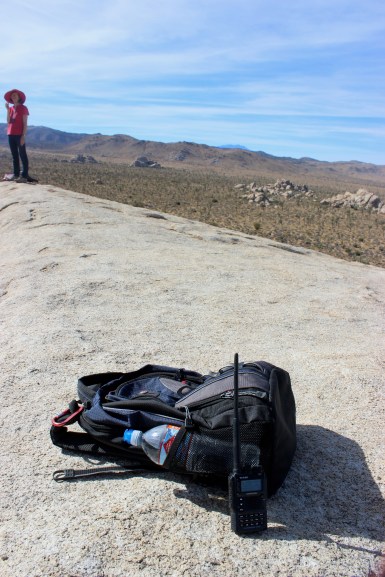
As expected I was never able to bring anyone up on the 2m calling frequency (146.52Mhz) and I never heard anyone one calling. I gave a bunch of calls from the desert floor as well as a couple hundred feet up on top of the Hall of Horrors (a rock climbing area in the park).
 

IMG_5060

From on top I was able to hear conversations on the N6LXX linked repeaters (good quality on 2m and 440 and passable on 6m, my first 6m repeater ever heard live!)

From the top of this mini mountain, I was able to get the repeater tail when doing a radio check, but was never able to get anyone to return my call.

Back on the ground

IMG_5166

When I was back on the desert floor I was still able to hear conversations on the N6LXX repeaters but couldn’t seem to get into the repeater with just my rubber duck.

When I did some more bouldering I set up the APRS on my VX-8R and was able to decode some good packets. Since I don’t have the GPS attachment for my Yaesu I wasn’t able to get a good location put in manually. I did a little math in my head to convert from my map lat/long to the Degrees Decimal minutes, so wasn’t sure what the error bars on my reported location really was. Heard some real people and some weather stations.

No one had a calling frequency in their packets so I didn’t make any attempts to call.

I’m pretty sure I was getting direct decodes as opposed to going through a digipeater. I wasn’t ever able to get digipeated and didn’t see my call end up on aprs.fi.

Lessons Learned

I should have brought my roll up j-pole to get out better

I should get an app to give me the exact lat/long format that the Yaesu needs for manual position reporting

If I had more time I might have brought my 40m QRP rig and tried some SSB

FRS radios would have been helpful around the park / hiking with the family since there was no cell phone service

Satellites would have been VERY doable due to the clear horizon pretty much everywhere


Amateur Radio and the Great American Eclipse – Aug 2017


IMG_4719

I decided to to Idaho to see the total eclipse in August 2017, as did a couple hundred thousand other people. Getting from Salt Lake City to Pocatello was a piece of cake, getting to Sugar City in the middle of the night before the eclipse was also a piece of cake. The eclipse itself was almost indescribable. Getting back was CRAZY (but was expected). We were stuck in traffic for 8 hours! We had mostly prepared making sure we had plenty of food, water and gas to make it a couple of days if needed, so an 8 hour drive was not too bad, though it really seemed to be something the likes of that Idaho had never seen. We spend the better part of 3 hours in Blackfoot, ID itself going about 8 blocks. It was so slow I was able to get out of the car and walk around town, finally catching up right before 91 started to pick up again.


Preparations

In planning for the trip, I brought my 2m/440 HT and a set of FRS radios. We were camping so I expected to be well out of cell phone range and wanted both types of radios to talk to people in camp / while driving who didn’t have radio licenses, as well as farther out.

This was a rare case where 146.52 was active and came in handy. Once we were stuck on the road I put  up my mini mag mount (UT-106UV Dual Band Whip $12 from Amazon) and my Yaesu VX-8R. I had preprogramed simplex and repeater channels before I left on our trip and they came in handy. The most used were 146.52 and some of the linked repeaters. Net control was great and was taking traffic reports from around the area. This in combination with Waze/Google maps showed that things were bad all over. Waze and Google Maps were overwhelmed and their instructions and timings were not to be believed. Everything was bumper to bumper and stopped. We eventually just got way off the main roads and things cleared up.

Things to think of in the future:

  • Pre-programming was a great thing to do, I heard many people asking for other repeater frequencies
  • 146.52 was very active and local, I heard general travelers plus caravans using the frequency
  • In camp the day before the eclipse, I could raise repeaters but never got a reply from anyone.
  • In camp, 146.52 was mostly dead, but I heard one person from Pocatello calling but I could never raise them
  • My cheap mag mount was great, feels like a toy but worked well enough with an adapter with my VX-8R and stayed on the car even at 80 mph
  • We picked a hybrid as our rental car. It averaged over 40 MPG which really put me at ease with all the concerns about traffic and gas stations running out of gas. We saw many cars with jerry cans strapped to their back. The car reported a range of over 500 miles which I believe. We returned the car with plenty of gas.
  • The FRS radios were nice since I could take a hike and keep in touch with camp
  • I thought about using APRS but it was one more thing to carry. I wish I did, but didn’t really have a chance to look or play around with it anyway even though we were stuck in the car for hours, we mostly talked and played games. Would have been interested to use for ham to ham messaging for conditions


IMG_4753

Replacement screws for a Kantronics KPC-3

I have a KPC-3 TNC and lost one of the screws a long time ago. I finally lugged it down to the local hardware store and figured out a replacement for the missing screw.

The replacement I got was a 3-48 x 1/4 pan head screw since that was the shortest they had.

You should get a 1/8 version if you can.

You should be aware that there is a side that can take a long screw and one that can only take a short screw.

I put the original short screw on the short side and the replacement “too long” screw on the long side.


This blog contains information about amateur radio projects I’m working on.

I’ve been licensed since 1994 and mostly do VHF/UHF with a little HF and digital modes.

I am mostly a software guy, though dabble in Arduino and embedded electronics here and there.

I volunteer with the San Francisco NERT program and like helping people get and star using the radio license