How to fix Motorola SX700 that won’t charge in the drop charger!

I was going though my pile of radios and found my Motorola SX700 FRS radios from 2005 or so. I had new replacement NiMH batteries and put them in. When putting the radios in their drop chargers, one charged nicely (lighting the red LED on the AC/DC adapter) while the other one would not cause the red LED to light unless I pushed it hard into the charger.

What the problem with my radio was that both metal springs on the battery DOOR needed to be pulled slightly out, once I did that the drop charger charged the radios as expected.

Replacement battery for Braceus Digital LCD clock

A couple years ago I purchased a small inexpensive digital clock for my radio go box. I typically keep it in UTC time. Recently the battery died and I went to replace it but lost the original battery before I had a chance to order a new one. Certainly the battery type will be written on the clock or on the product page I said to myself! NOPE! I had some button batteries that were the correct diameter but too thick to close the battery door. This post is to help anyone else in my same situation. If you have a small digital clock that says “Quartz” and has a white band around the display and was sold on Amazon with the name “Braceus Digital LCD Screen Table Auto Car Dashboard Desk Date Time Calendar Small Clock” or similar with a variety of other names on Walmart or aliexpress, etc…

The clock takes LR1130 or AG10 Battery 1.5V Long-Lasting Alkaline Button Cell Batteries.

Getting photos off a 15 year old flip phone with BitPim in 2024

My mom wanted us to get the photos off her old 15 year old flip phone, a LG VX 5600. This phone no longer had service, no ability to get service and had no easy way to copy images off the device to a computer. I did some research and saw 2 good Open Source choices that might work BitPim and Wammu/Gammu.

At first I wasn’t able to get either working on a modern computer (windows, linux or MacOS) All failed for various reasons but mostly due to weird error messages and incompatible or missing libraries.

I remembered I had an old laptop that could run Windows 7 and decided to go back in time. Here’s the steps I found that allowed me to copy the photos and SMS messages off the device.

  1. First I installed Windows 7 onto my old Celeron laptop, I had a key but it wouldn’t take it so I left it in unregistered mode
  2. Internet Explorer was installed but had a lot of difficulty in going to many modern web sites (maybe due to certificates / etc..)
  3. I used IE to download Supermium, a Chrome fork for old windows OS versions. https://github.com/win32ss/supermium
  4. I used this to download the LGUSBModemDriver_WHQL_Eng_Ver_4.8.1.exe installer for the LG driver required for BitPim to talk to the phone. I used a possible dodgy site to get a copy since the LG site was crashing my browser no matter what I did
  5. I installed the driver and rebooted
  6. I downloaded BitPim 1.0.7 for Windows and installed it
  7. It needs a couple MSVC DLLS which I needed to go to various places to download, mostly for MSVCP71.DLL You’ll have to find a copy of this file on the various dodgy sites as well
  8. I copied that DLL file into the BitPim directory
  9. I plugged in the phone using a USB cable and started BitPim
  10. Make sure the phone is flipped open and turned on
  11. I used Edit->Detect Phone to make sure the phone was visible to BitPim and Windows
  12. I then went to Edit->Settings and selected Phone Type: LG-VX9100 (env 2) since I read that works well enough to copy photos and SMS messages from the phone in various threads even though BitPim doesn’t officially support the VX 5600
  13. I also checked the “Read Only” checkbox in the settings to block writing to the phone
  14. To download Photos: I then clicked on the Green arrow to Get Data from phone and select Wallpaper, it took a long time but the photos were copied over to BitPims local storage
  15. To download SMS I checked SMS from the Green Arrow Get Data from phone
  16. Do NOT check the Phonebook since it will likely crash BitPim
  17. Once the photos and SMS were downloaded to BitPim you can export them to your local disk
  18. It looks like you can navigate to BitPim->Phone->Media->images and then select all and right click to save… to a local destination
  19. I also used the File->Export Media to Zip file to export the photos to a zip file
  20. I then confirmed the photos I expected were in the zip file
  21. Export SMS in a similar way if desired
  22. You now have exported the photos and SMS from your LG VX 5600 to a computer! Hurrah! Copy them off your Windows 7 machine to save permanently.
  23. I couldn’t get the PhoneBook to copy off the phone without crashing BitPim possibly another LG phone in the settings would work, or possibly you code fix the source code. I didn’t care about the phone book so didn’t work too hard on this.
  24. Good luck!

Ham radio on my Eclipse roadtrip to NH

A little eclipse travelogue, a little emergency preparedness story. We travelled to New Hampshire from Boston to go see the eclipse yesterday and I brought 2 radios based on my experiences in Idaho during the last eclipse (That time we were stopped on highway with non-working cell phone network for 12 hours)

This Monday we thankfully got out right after totality and picked a location where we could be the front of the line instead of the back of the line [we stayed south of the main place people were going to give up 15 seconds on totality to save 6 hours of additional driving!]

Brought 2 handhelds, by Yaesu VX-8R for VHF/UHF voice and my Baofeng UV-5R+ for APRS position reporting and viewing via PocketPacket on the iPhone. Brought a single VHF/UHF mag mount and adapters to swap radios out if needed.

The drive went much quicker than expected and we didn’t end up getting stuck without cell phone or feeling like we didn’t know when we were going to move again. Waze seemed believable and got a signal enough to update periodically even in the White Mountains.

My friends left 20 minutes after us and their drive took 7 hours longer!

What worked:
I preprogrammed all of Vermont and New Hampshires repeaters into my radio using CHIRP
I have the standard simplex freqs and my local repeaters programmed in as well

What didn’t work well:
My good mag mount got pulled into 2 and I couldn’t get the SWR in the right place for my trip after reassembling
Used a backup magmount, but don’t know how well it worked and couldn’t get SWR below 2.x
Repeater management is still TOO hard in CHIRP esp if you are doing a road trip. I know there are a couple other apps, but I haven’t had good experiences with them in the past.
In Idaho I programmed a bunch in, but in the end used Repeaterbook’s pretty good OFFLINE GPS enabled iOS app and programmed the closest repeater by hand since I was stuck not moving anyway.
I used Repeaterbook’s online route planning dump, but ended up just programming ALL VT/NH repeaters since I was tired of playing around with CSV files, the exports seem broken but fixable from the website but I was tired.
I need to go out and buy a bunch of my “happy path” adapters. I have a million N to TNC or whatever, but always struggle to find the right SMA to UHF or SMA to BNC
Never got around to APRS since it wasn’t needed but might have been more interesting, heard some repeater traffic but being in the mountains it was very scratchy and my 5 watts couldn’t open any of the repeaters.
I kept crunching my coax in the window when trying to close my other window. I need to tape over the window control to prevent that next time or just close it in the door instead of the window.
In the end I was glad I had the radios, glad I didn’t need them, felt I could get some functionality from them if needed, but mostly it was a good planning exercise.

Next time:
Would bring my 25 watt VHF/UHF radio as my main voice rig
Bring the handheld as a backup
Need to label and tune all my mag mounts. I have too many that I’m not sure if they are 10m or 2m
Tape over window control to prevent damaging my coax by accidentally closing it all the way (edited) 

MagLoopTuner: A utility to help tune your magloop quicker

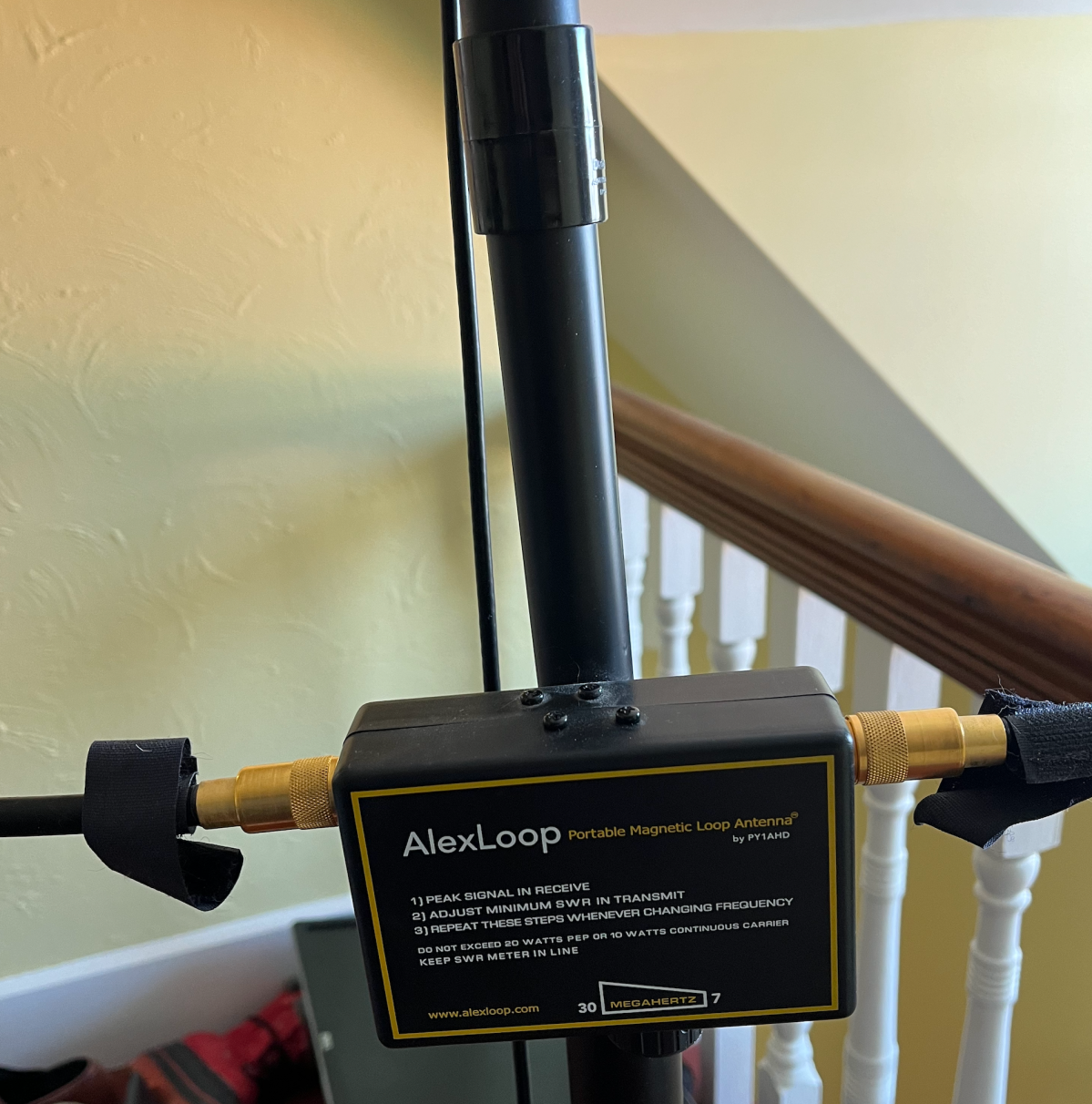
I have a AlexLoop mag loop antenna. My new shack has the antenna in the hallway outside my shack which makes it harder to tune the antenna. Typically I would watch the S meter on the radio’s front panel and using that and the highest noise be able to quickly get my antenna tuned. By moving it out of the room it became really hard to do the back and forth process to get it tuned correctly.

I wrote a small utility to make this process MUCh faster. This utility will read your radio’s S Meter using Hamlib and speak the value aloud to you once a second. Listen and Tune for highest S Meter reading. You can get the utility and instructions on my Github: https://github.com/jeff-luszcz/MagLoopTuner/

By default it is set up to use the FT-450D on /dev/ttyUSB0 and a baud rate of 38400. These can all be configured by editing the script.

Ham radio on vacation in Maui

I just got back from a lovely vacation in Maui. I though it would be fun to bring my VHF/UHF radio along in case I got some free time to listen in, join a net, or do some APRS monitoring.

Long story short, I ended up having about 15 minutes free one night and had some fun checking in on the APRS traffic. Among others, I managed to snag a signal from 100 miles away in O‘ahu which was a surprise (we were both pretty high up on our respective islands)

What I did to prepare: I programmed my radios using CHIRP the repeaters for Maui as well as some specific linked repeaters from the XO group. I printed out the map from the XO group as well

See https://www.kh6rs.com/blog/xo-group-statewide-repeater-system

I also printed out the very nice Maui repeater map from https://www.kh6rs.com/repeaters.html

When I had free time late at night the repeaters were quiet and I didn’t want to wake anyone up!

If I did this again I’d want to bring a bluetooth APRS dongle and use my smartphone for mapping and messaging instead of just my VX-8R. I don’t have the GPS module for my VX-8R so I need to hand program in my location which is helpful for figuring out how far the signals I receive are away from me, and would be useful to plot my location if I decided to transmit it.

I’d also look at POTA and SOTA since everyone in the local radio club in SF told me that I _should_ have done that!

At the end of our trip were were starting to have some quiet days which might have given me some free time to play radio, but since our travel mates caught COVID we decided to go home a couple days early so if we got sick as well, we’d be back home.

All in all, a beautiful place for a vacation!

Insignia 55″ TV code for RCS Remote RCRN03BR

Spent an hour figuring this out tonight, maybe this will save you some time.

I have an RCA universal remote model RCRN03BR and an Insignia 55″ TV model NS-55df710na19

The remote seemed to have lost its code memory and wouldn’t work again so needed to be reprogrammed.

I tried all the auto code searches but kept getting almost but not quite there. I ended up trying all the Insignia 5 digit codes and found one that seemed to work okay.

12049

(hold down the TV button while typing in the 5 digit code) the remote should work as expected.

Things I learned trying out Winlink VHF this month

This month our radio club decided to all try out Winlink for VHF. Here are some of the things I learnd while trying it out this month.

I did a big closet clear out during the pandemic and gave away / sold a bunch of my older ham hear including my physical TNC, a Kantronics KPC-3. I have a couple signalinks and have had some luck in the past with direwolf so I decided to sell my old physical TNC and associated radio.

We have a new VHF Winlink node in San Francisco, in addition to the nodes in Marin and Oakland. I was hoping I’d have decent luck being able to hit it with my 5 watts from my ft-817.

I decided to build a Winlink station using my Yaesu FT-817, a Signalink and Linux. To get access to Winlink I tried out both Winlink Express under Wine and Pat under Linux (which requires AX25 support)

My existing laptop had GalliumsOS which has been very nice for a few years, but I found that I couldn’t get AX25 support running there (there was some notes of some kernels with it built in, but I couldn’t track them down easily)

I tried a couple other distros and found that Fedora Workstation ships with AX25 kernel support (though you need to explicitly load it)

Here’s what I learned:

  • High power radio is best, my ft-817 5w QRP for QRP or HF just doesn’t cut it. I couldn’t make contact with any of the VHF nodes though I could get into APRS digipeaters and a local Packet BBS
  • Choose Windows over Linux. While I managed to get the software side installed on Linux, the Linux AX25 framework and tools feel fragile. Good to understand and “work” but don’t really seem useable in an emergency or for “sometimes” use. Seems like it would be fine for a dedicated 24/7 connection.
  • Real TNC vs Signalink? Kind of a toss up. I never had any problems with my physical TNC under linux but the sound card interfaces are a bit fragile and cause port issues on start/stop of the interface or direwole. Nothing that isn’t unsurmountable but a level of complexity that’s annoying for “once and a while” usage. I know I could probably do more configuration to force reuse of ports, but couldn’t find an easy recipe….
  • I wish I kept my KPC-3, it “just works” and its one less thing to configure under Linux.
  • ‘axcall’ vs classic terminal program: axcall works but doesn’t seem as useful and stable as the classic serial terminals I’ve used. 
  • A VHF/UHF win link node would be a great addition to the East side of Twin Peaks. I can’t seem hit or hear any of the East Bay, Marin or Sunset nodes. 
  • I would likely dedicate a machine to Winlink only if I set this up permanently instead of trying to have it support aprs, classic packet and HF digital modes

For AX25 under Fedora Linux I found the following useful:

I installed the latest Fedora Workstation on my latop
I needed to load the ax25 kernel module using the instructions at http://xastir.org/index.php/HowTo:AX25_Fedora (the part near modprobe -a ax25)
I watched the two parts of this walkthrough of the install of the various parts of pat / direwolf  https://www.youtube.com/watch?v=oZJJLfVz23k
I followed along here for the VHF parts (ignoring ARDOP etc…) https://rockfloat.com/ham/pat_linux.html
In the ax25.service file I used the following since I have a Signalink instead of a physical serial port. Direwolf creates the /tmp/kisstnc device

ExecStart=/usr/local/bin/ax25-up /tmp/kisstnc wl2k 1200

instead of

ExecStart=/usr/local/bin/ax25-up /dev/ttyUSB0 wl2k 1200

Hope this helps you.

I’ll likely try this again with my Kenwood TM-D710 and ty it with high power and see how it goes.

Looking forward to the radio year ahead

The new year often gives us a chance to look forward and backward on your hobby and decide what to do more or less of in the upcoming year.

With the pandemic, I’ve been staying close to home, though surprisingly with less free time than I expected.

In the last year I had a chance to get my shack-in-a-box/gokit to a pretty good place. I’m able to listen to HF or VHF/UHF anytime I want and have made more QSOs in the last year than ever before. That said, the bands have be pretty dead and my ability to talk on HF has been limited to SSB with the Pacific North West and some FT8 and JS8call.

On VHF/UHF I’m continued with my weekly simplex net (9+ years running) and some other local use (listening to 146.52 calling frequency, some other simplex and club nets) I wish there was a better database of nets to make it easier to find and join them!

I spent a few months setting up a SatNogs satellite receive station for the NOAA and other satellites. I had a comprise antenna (a 137 MHz v-dipole IN THE HOUSE) but still had a really good time getting some decent decodes of the NOAA weather satellite images. I’d love to rebuild a v2.0 of this antenna and receive station and get the antenna outside. I had to take this setup down due to needing the space for another project.

I’ve done a little elmering / mentoring of new hams through the SFFD NERT program which is always rewarding.

I’ve continued with some limited APRS and old school packet BBS use.

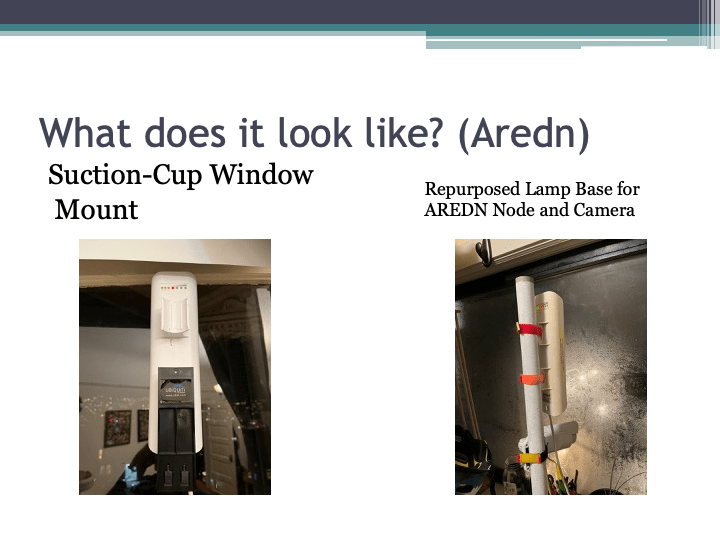
In the last year I’ve had a nice time building out a set of AREDN nodes and hooked them into the SF network.

I’ve only had a limited chance to do any traveling or camping but when I’ve done I’ve either taken my VHF/UHF HTs with me, or in a couple times taken my ft-817 and end fed. I’ve had no luck with QRP SSB when camping unfortunately. I spend 99% of my travel time talking on FRS with the family!

I often bring my WLD KD-C1 16 channel radio with my when I’m out and about. It’s programmed with 446 simplex and then “best’ 15 other repeaters for the Bay Area.

My 2021 plans

I plan on keeping my AREDN network up, and possibly adding some services to it like a Raspberry Pi and may one some emergency power for at least one of the nodes.

I’m temped to move the location of my shack to the back of the apartment to get me better antenna location and get me further from the access point which has been resetting too much when I transmit!

I’d like to have a more permanent HF and VHF SDR set up. I’ve been careful to not have my SDR set up when I transmit on the HF and VHF station but it would be nice to have a panoadapter view of HF and VHF

My HF digital set up lives in a backpack, I’d like to have a permenent setup with fewer cables. It’s a rat nest right now (3 USB cables to get on HF and VHF!)

I’ve seen people have good luck putting a Raspberry PI in that rack and then VNCing into the rpi. This will definitely cut down on cables, though at the cost of network complexity and possibly impacting my power budget and complexity. If I end up moving the rack I’ll definitely embed a rpi for remote access!

The other thing I’ve done is get rid of a lot of radio projects I just was never going to get around to. I passed along my external HF tuners (I regret getting rid of both though!) and I got rid of all my 2Ghz HSMM gear. I had thoughts about setting up a 2GHz access point to my AREDN portable node, but I just have too many things on my plate.

Things I probably won’t be doing this year

I really wish I practiced my CW more, especially with the bands being so bad. I’ve always wanted to be able to being a super small QRP CW rig and antenna while camping. I just haven’t heard enough to get in good practice, though a local club has started doing 2m CW…..

I probably won’t finish my Pixie 2 QRP rig until I get some consistency good HF conditions, it’s too hard to know if its working right now and I want to get it perfect before I mount it in an altoids case, etc…

I had a couple radio software projects I was kicking around but they have taken a back seat for now. I hope to get one done and in the App Store before the end of the year though!